
Nexaflex
Lead Mobile Engineer
· Completed
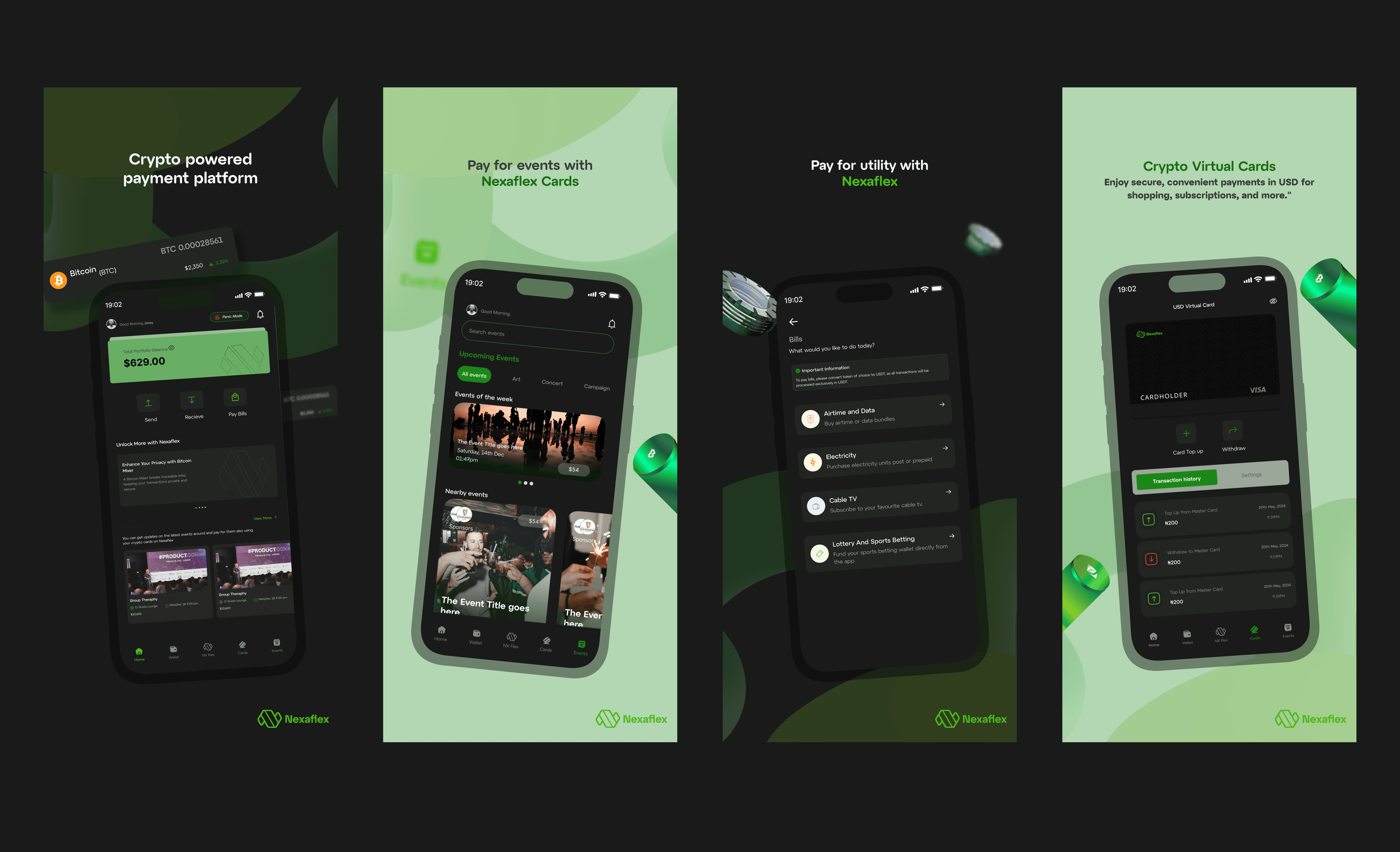
What Nexaflex does
Nexaflex is a crypto-native finance app, live on both stores at v1.9.1: users hold and move digital assets across eight chains, spend them through a USD virtual card, pay real-world Nigerian bills with them, and buy event tickets. I led the mobile build.
The security architecture
The app was rebuilt around it. SecureLockManager keys lock data in
expo-secure-store to the account identifier, so when a different user
signs in on the same device the previous user's PIN, panic PIN and
biometric settings are wiped automatically.
Panic mode gives the user a second PIN that unlocks the app into a
decoy state: balances mask, the tab bar swaps in a decoy screen, nothing
sensitive is reachable. It is built for the case where someone is being
forced to open the app. Around it: biometric unlock, a separate passkey
credential gating high-value actions (card detail reveal included),
AppState-driven auto-lock on an idle threshold, and a JWT access/refresh
pair in secure storage with silent refresh and forced logout on refresh
failure.
The quote-polling engine
Withdrawals, swaps, tickets and bill payments each run a polling hook —
useQuotePolling, useWithdrawalPolling, useTicketQuotePolling,
useBillingQoutePolling, where quotes auto-refresh on an interval,
expire on a validity window, back off after consecutive failures, and are
re-validated immediately before submission. A user never signs a stale
price.
The rest of the build
A multi-chain wallet across Bitcoin, Ethereum, Solana, Tron, BNB Chain, Avalanche, Polygon and Arbitrum, with per-network deposit addresses and ERC20/TRC20/BEP20 abbreviation handling so users don't send funds to the wrong chain, aggregated into a single fiat portfolio value: QR receive with screenshot export, camera-scanner send with address and network validation, asset-to-asset swaps, and per-transaction receipts.
A USD virtual card with issuing, freeze/unfreeze, spending-power display and deposit/withdraw against the crypto balance at a quoted rate. Bill payments from a crypto balance: airtime, data, electricity with meter validation, cable TV and lottery wallets. Every biller runs the same check-quote → confirm → buy pattern. Events with QR tickets saveable to the camera roll, Bitcoin mixing behind a four-page educational walkthrough with an explicit consent gate, and tiered KYC (levels 1–3) with NIN, passport or voter's card, BVN capture and document upload.
Resilience on unreliable networks: TanStack Query state persisted for 24 hours so the app opens with real data rather than spinners, resilient balance hooks serving cached values instantly while surfacing cache age to the UI, layered cache services retaining stale data up to 7 days with explicit staleness signalling, and MMKV backing the synchronous hot path.
The architectural convention throughout: screens never call axios directly — everything routes through a layered client, server data lives in TanStack Query and only UI/session state in Zustand, and anything sensitive goes to secure store, never AsyncStorage.
Live on both stores
Live on the App Store and Google Play at v1.9.1 (iOS build 4, Android versionCode 11).