
UWA
Lead Mobile Engineer · Uwa · Nigeria
· Completed
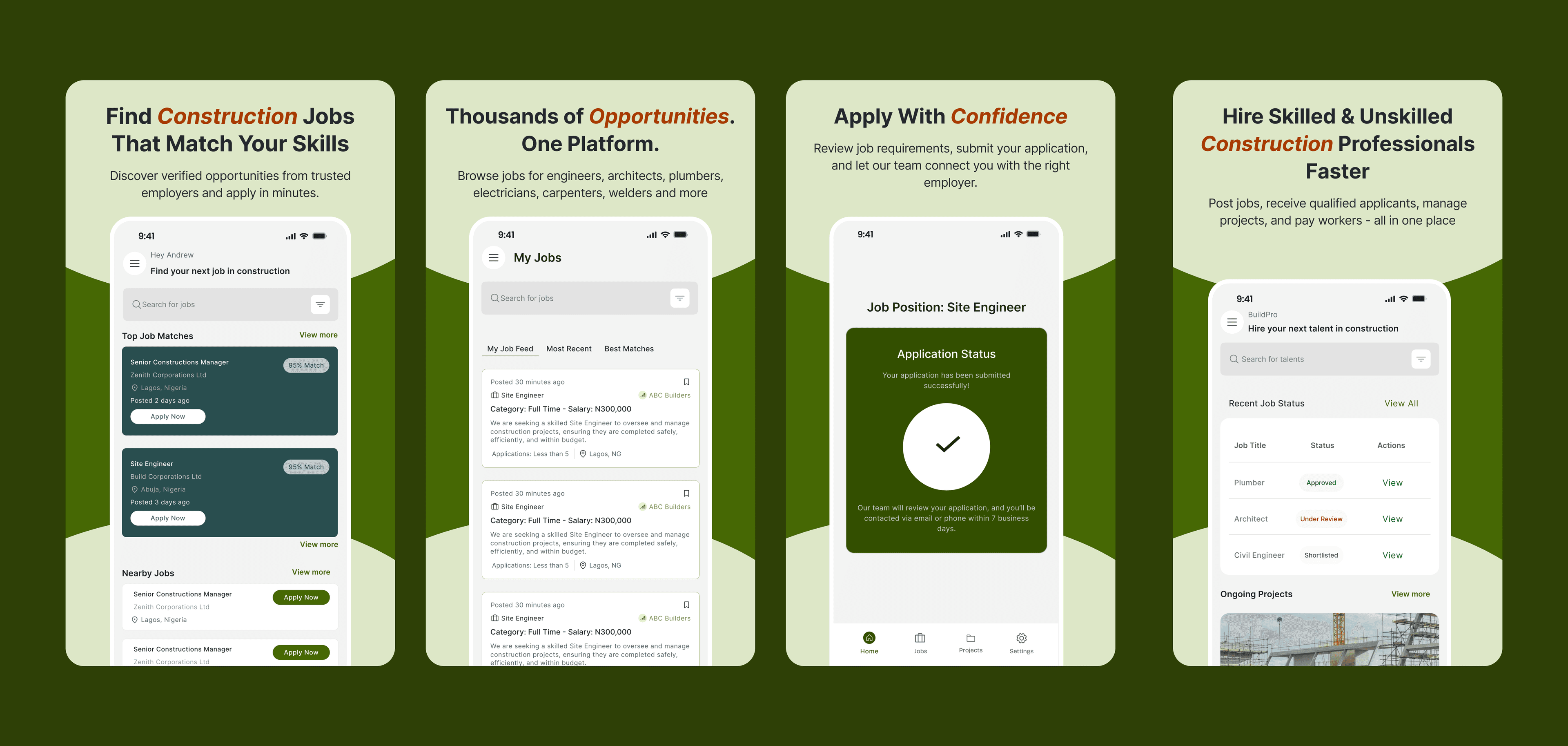
Two roles, one binary
UWA is Nigeria's marketplace for skilled and unskilled labour: a React
Native (Expo) client for uwa.ng connecting employers who need workers with
talent looking for work. It carries the whole employment lifecycle for both
sides of the market in a single binary, with one navigation shell that
reshapes itself on user_class rather than duplicating screens per role.
Both sides of the market
For talent: job search and filtering by text, location and employment type, saved jobs and best-match scoring; applications with cover letters and a pending → shortlisted → hired status timeline, withdrawal, and hire accept/reject; an in-app résumé covering experience, education, skills, certifications and CV upload; a media-rich project portfolio; clock-in/clock-out producing auditable attendance history; a wallet with payment requests, Nigerian bank account addition and name resolution, and withdrawals; identity verification, support ticket threads, in-app blog and push.
For employers: full job posting with pay-to-activate and draft completion; per-job applicant review with status filters and full candidate profiles including downloadable CVs; project tracking with clock-in audits across all workers or per project; a four-tab payments hub covering job payment requests, talent payment requests, transaction history with PDF receipts, and bulk-labour invoices.
Bulk Labour Requests was the heaviest feature: multi-role staffing requests with per-role headcount, duration, location and supporting documents, tracked through review, with in-thread messaging to the Uwa team, invoicing, full or instalment payment via Paystack, and PDF export.
Paystack, pagination and PDFs
- Paystack checkout opened through
expo-web-browser's auth session with the return captured via anexpo-linkingdeep link — no WebView hacks, nowindow.location. Reused across job activation, notification-triggered payments and bulk-labour invoices. - The bulk-labour invoice view composes four separate endpoints in parallel
via
useQueries, normalised behind a singleuseBulkLabourInvoicehook, with full/partial payment branching. - A custom
useInfinitePagedQuerybuilt onuseQueriesafter bothuseInfiniteQueryand a setState-accumulator approach proved unstable. It normalises the three different response shapes the API returns into one flat array. - An axios client that never throws:
validateStatus: () => true, timeouts and network errors normalised into{status, data}, 401 auto-logout. - PDFs rendered as HTML and printed with
expo-print. That matches the web client's jsPDF output without pulling a DOM-coupled library into the bundle. - TanStack Query persisted to AsyncStorage so the app restores its cache on cold start and resumes paused mutations.
- A 13-milestone (M0–M12) web→mobile parity programme: the gap was audited feature-by-feature and closed idiomatically for React Native rather than porting the React web client screen-for-screen. Divergences were recorded deliberately: bottom sheets over centred modals, FlashList cards over multi-column tables, chip rows over dropdown filters.
Live on Google Play
Live on Google Play at v1.0.0 (iOS build 81, Android versionCode 12). The engagement ran two years, concurrently with up to four other contracts.